

Choosing the right eCommerce platform is a big step for any business. Whether you’re launching your first store or looking to upgrade, the right tool can make all the difference in scalability, ease of use, and long-term success.
Here’s a breakdown of four leading eCommerce platforms — Magento, WooCommerce, Shopify, and BigCommerce — to help you find the best fit.
📌 Magento 📌
Best for: Businesses of all sizes looking for flexibility, affordability, and room to grow
✅ Pros:
- Free to start: The Magento Open Source version is completely free
- Easy to set up: No special knowledge required for basic store setup
- Feature-rich: Already includes core functions like product management, orders, shipping, and SEO
- Highly extensible: Thousands of free and paid modules available to add almost any functionality
- Scalable: Works for small shops and enterprise-level operations alike
❌ Cons:
- Complex Setup: Requires professional developers for setup, maintenance, and scaling.
- High Cost (Adobe Commerce): The enterprise version is very expensive.
- Resource-Intensive: Needs powerful hosting and regular updates.
📌 Shopify 📌
Best for: Beginners, small to medium-sized businesses, and drop shippers.
✅Pros:
- User-Friendly: Easy to set up with a drag-and-drop interface and tons of themes.
- Hosted Solution: No need to worry about server management or security.
- App Ecosystem: Thousands of apps to extend functionality.
- Excellent Support: 24/7 customer service and comprehensive documentation.
❌Cons:
- Monthly Fees: Pricing starts at $39/month, and additional fees apply for premium apps.
- Limited Customization: Unless you upgrade to Shopify Plus, deep customization can be tricky.
- Transaction Fees: Additional fees if not using Shopify Payments.
📌 WooCommerce 📌
Best for: WordPress users, bloggers, and developers looking for flexibility.
✅Pros:
- Free Core Plugin: Open-source and free to use (though hosting and add-ons cost extra).
- Highly Customizable: Full control over design and functionality.
- Large Community: Extensive plugin and theme ecosystem, with lots of support available.
- Content + Commerce: Perfect for content-driven businesses.
❌Cons:
- Requires Technical Knowledge: Not as beginner-friendly; regular maintenance is needed.
- Hosting Required: You’ll need to manage your own hosting, backups, and security.
- Performance Can Vary: Depending on hosting and plugin use, performance may need optimization.
📌 BigCommerce 📌
Best for: Growing businesses and B2B sellers who want scalability without complexity.
✅Pros:
- No Transaction Fees: Even with third-party payment gateways.
- Built-in Features: Advanced SEO, multi-channel selling, and strong B2B capabilities out-of-the-box.
- Scalable Infrastructure: Handles spikes in traffic and large product catalogs well.
❌Cons:
- Learning Curve: More features = steeper learning curve for some users.
- Pricing Tiers: Plan upgrades may be required based on annual sales volume.
- Design Limitations: Fewer theme customization options compared to Shopify or WooCommerce.
🧩 Quick Comparison 🧩
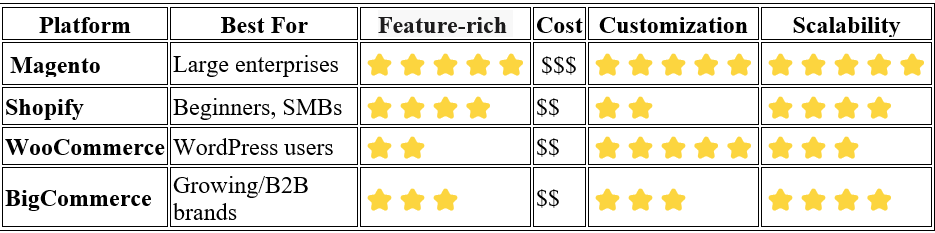
There’s no one-size-fits-all answer. Here’s a shortcut:
- For Magento, there are already many free and paid modules that can be used to add almost any functionality.
- Go with Shopify if you want something quick and easy.
- Choose WooCommerce if you’re already on WordPress and want full control.
- Pick BigCommerce if you’re scaling fast or need strong B2B features.
Think about where your business is today — and where you want it to be in a year. The best eCommerce platform is the one that grows with you.
If you have any questions about your project, please write to us https://synpass.pro/contactsynpass/ 🚀
We are happy to help🤝